
Il n'y a plus d'articles dans votre panier


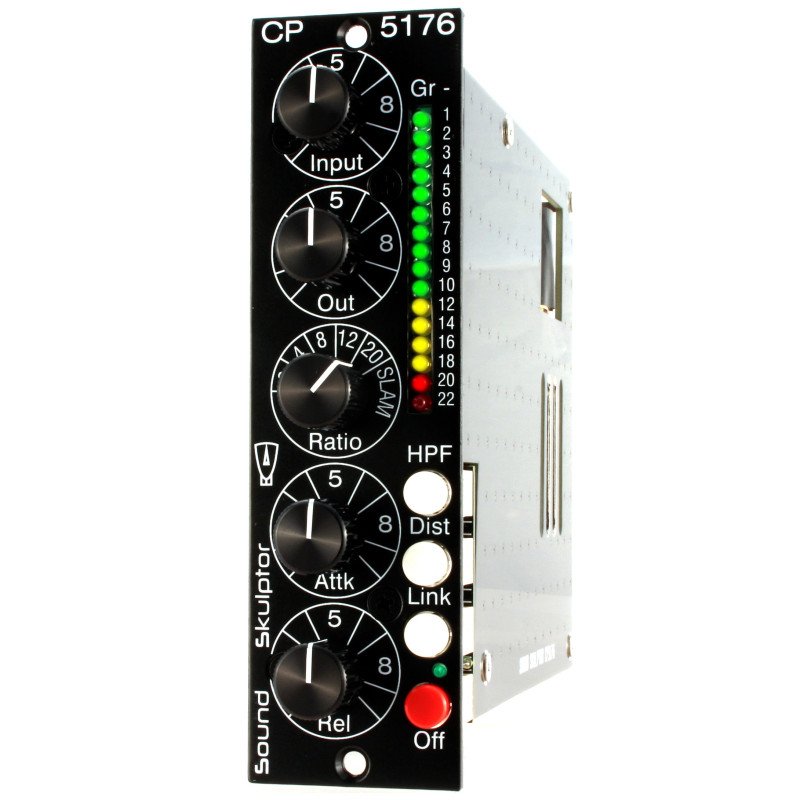
Le CP5176 est un compresseur à FET, basé sur le design du compresseur 1176LN, qui a été adapté au format '500' d'API*.
 Paiements sécurisés
via Paypal, Stripe ou virement
 Livraison monde
Expédition les lundis et jeudis.
 Politique retours
(à modifier dans le module "Réassurance")
Le CP5176 est un compresseur à FET, basé sur le design du compresseur 1176LN, qui a été adapté au format '500' d'API*.
Ce compresseur doit sa popularité à des caractéristiques particulières telles que son temps d'attaque extrêmement court (20 microsecondes) ainsi qu'à une sonorité unique, liée au transistor FET, à la classe A et aux transformateurs.
Il est classiquement utilisé pour la compression de la caisse claire, du chant, des guitares ainsi qu'en stéréo sur le bus batterie.
Le CP5176 ajoute quelques fonctionnalités au 1176 original, telles qu'un nouveau ratio de 2, un filtre passe-haut dans le circuit de sidechain ou encore une variante du circuit réducteur de gain à FET produisant plus de distorsion.
Il vous suffit de l'installer dans votre rack LunchboxTM compatible API* pour commencer à travailler.
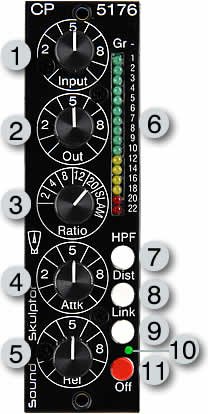
1 Input : Potentiomètre réglant le niveau du signal avant compression. Détermine le seuil de compression.
2 Out : Potentiomètre réglant le niveau du signal après compression (make up gain).
3 Ratio : Commutateur déterminant le ratio de compression entre 2 et 20. Le ratio 2, permettant des compressions plus subtiles, a été ajouté au circuit original. Le mode SLAM correspond à l'appui simultané des 4 boutons sur le 1176.
4 Attck : Potentiomètre réglant le temps d'attaque. Détermine le délai avant l'action du compresseur.
5 Rel : Potentiomètre réglant le temps de retour. Détermine le temps que met le compresseur à revenir à l'état de repos.
6 Gr : Affichage de la réduction du gain à haute résolution: 16 LED's de -1dB à -22dB.
7 HPF : Insertion d'un filtre passe haut à 80 Hz dans la sidechain. Permet d'obtenir un Gros son et évite les effets de pompage au rythme des basses.
8 Dist : Modifie l'équilibre des signaux sur le FET, ce qui ajoute de l'harmonique 2. Proche de la version Rev A du 1176.
9 Link : Connecte deux compresseurs en mode stéréo.
10 LED indiquant le statut du bouton Off (bypass).
11 Off : Bouton de désactivation du compresseur (bypass par relais).
Absolument tout!
Vous apportez la soudure (choisir une soudure de bonne qualité, diamètre 1mm max) et la Lunchbox.
Le kit du CP5176 a un niveau de difficulté moyen. Rien de très difficile mais un nombre de composants assez important.
Les réglages sont simples mais nécessitent l'utilisation d'un bon voltmètre alternatif.
| Mesure | Conditions | Valeur |
| Courant d'alimentation au repos | Pas de signal d'entrée | V+ : +70 mA V- : -65 mA |
| Impédance d'entrée | f=1kHz | 13 kΩ |
| Niveau d'entrée maximum | déterminé par le transfo | +19 dBu |
| Niveau de sortie maximum avant écrêtage | f=1kHz | +27 dBu |
| Gain minimum | - ∞ | |
| Gain maximum | +42 dB | |
| Réponse en fréquence | Déviation=+/-1dB | 6 Hz - 27 kHz |
|
Distorsion harmonique totale (THD) f=1kHz |
sans réduction de gain | < 0.05% |
| avec réduction de gain | < 0.1% | |
| Bouton dist | 3% | |
| Temps d'attaque | de 20 us à 20 ms | |
| Temps de retour | de 50 ms à 1.5 s |
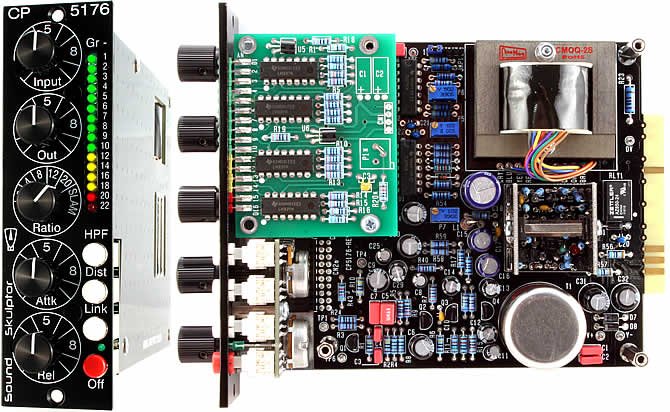
The CP5176 is an FET-based compressor designed for the 500-series format, heavily inspired by the classic 1176 architecture. It utilizes a discrete signal path, transformer-coupled input and output, and a high-performance SK25 Discrete Operational Amplifier (DOA) in its output stage.
The audio signal enters through a line input transformer, which provides initial balancing and isolation.
Following the gain reduction element, the signal is amplified to make up for the loss during compression.
The preamplifier is built using a DC coupled complementary transistor arrangement around Q2, Q3, Q4. The gain is approximately (R14+R9) / (R8+R4) ≈ 20.
The switch SW1 allows switching between Black Face style (less distortion) and the Blue Stripe style (more distortion) by modifying the local feedback loop.
The output drive is handled by the SK25 DOA (A1), which is a high-voltage, high-current discrete op-amp inspired by the API 2520. The gain of this stage is 1 + R20/R19 ≈ 5.5.
It drives a T2 output transformer (Cinemag), which provides the final balanced output (OUT+ and OUT-). A bypass relay (RLY1) is included for a true hard-wire bypass.
The sidechain circuitry determines how the FET reacts to the incoming signal.
The LED gain reduction meter utilizes two LM339 quad comparators to drive a 16 LED ladder. It shows gain reduction levels from -1dB to -22dB, using a mix of Green, Yellow, and Red LEDs to provide visual feedback of the compression depth.
I've been using my CP1176 for about 6 months now, on two to three sessions a week. After getting to know it well, I can tell you all with confidence that it is a great limiter & compressor, I thoroughly recommend it. It really does grab the attack at the quoted 20us while remaining transparent. A friend has lent me his unit and I've been using the two on my front end: the first set as a traditional limiter (super fast attack and fast release) with input (threshold) set to just catch the peaks, and the second as a compressor, with say 5ms or more attack time and slower release. This is an awesome combo and is giving a lot of clarity to my mixes. I've used it on vocals, acoustic guitar, electric guitar amps, bass (both DI and amps) and piano (no drums yet). Perfectly useable on all these sources.
Things I like:
1. Attack time 20us to 20ms. This varies from the "real" 1176 spec, whose slowest attack time is 800us (0.8ms). Having this longer attack time allows you to use it as a compressor and preserve some transient attack. This is a very worthwhile change to spec.
2. High Pass Filter. I use this nearly always on bass, it is a great feature.
3. Very accurate gain reduction metering. The 1db LED steps are great for dialling in the right amount of GR.
To the designer: Wishlist:
-switchable HPF of 80Hz and say 160Hz.
-Get rid of the DIST feature - I've never found a reason to use it. Perhaps replace it with a LPF at say 200 or 250Hz?
-External sidechain access (I understand 500 format makes this hard)
-a stepped pot version for those intending to build units for stereo use. I've used them in stereo and wasn't convinced my level calibration was correct.
-re-label the OFF switch to ON!!!
Keep up the good work Sound Skulptor, this is a great piece of equipment. I'm amazed at the pcb design and how you've managed to get so much circuitry in a 500 format unit.
This is the second Sound Skulptor kit I built as I was really impressed and happy with first. I already have an 1176 compressor clone, a Lindell Lin76, but the idea of having one in 500 format was really attractive and I knew the quality would be top notch.
Obviously, due to size, this isn't a one-to-one copy of the 1176 but it does everything my Lin76 does and has "that sound". A test with a drum loop I found online sounded huge. The gain reduction meter works really well too. Once again, I didn't get my moneys worth but I got a whole lot more.
Documentation was thorough and detailed. The setup guide was easy to follow and, although I have proper test equipment like a function generator and oscilloscope, I just adhered to the guide using basic equipment and I got a perfect result. I highly recommend this kit without hesitation.
Very well packed with comprehensive instructions. Just unbelievably fast delivery inside EU.
Just finished assembling. Very fun and easy to build. Very musical compressor, can easily go 10+ GR without pumping. Unless the most software emulations of the 1176's on the market, with added highs when compressing, this compressor actually smooth out the highs a bit, which I really love in this digital era.
I was really struggling to get transparent level control of my vocal recordings. My La2a clone was just pumping too much and it sounded unnatural. This thing completely solved the problem. This compressor is awesome.
J'ai deux 5176, deux hairball 1176 et un kt-76. Le kt-76 n'est pas mal, les hairball sont vraiment top mais ils coûtent plus du double. En gros, je n'ai rien trouvé de mieux qualité/prix. Sans hésiter, si j'avais besoin d'un autre 1176 je reprendrais un 5176 (c'est pour ça que j'ai deux unitées, en "fet" ;P)
Great layout, great documentation, great price and of course the most important thing: GREAT sound!
Next up is an LA502, a pair of EQP501's and a CP4500. Based on this kit, I'm pretty confident those won't disappoint me at all.
For the record, I had never soldered before I bought my first Sound Skulptor kit (CP5176). My CP5176 is about 2 years old now, and still running strong. I use this on literally everything I record. I am not professionally trained in the recording arts, but to my ear, this compressor is awesome. I am currently running it in series with the LA502 before it, and it makes for some really sexy Vox and Bass.
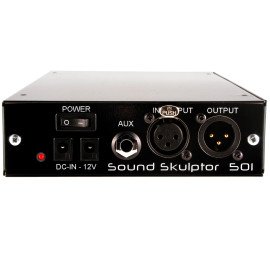
Le SK01 est un boîtier avec une alimentation pouvant héberger un module de la série 500.
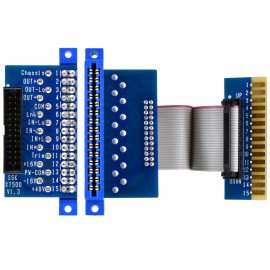
Le XT500 est un câble d'extension qui vous permet de connecter un module de la série 500 à sa Lunchbox out le laissant restant à l'extérieur afin de pouvoir effectuer des réglages ou de la maintenance facilement.

Ce tournevis a une tête encastrée à une extrémité qui l'empêche de glisser de la vis du potentiomètre ajustable que vous réglez. Très pratique lorsque vous travaillez dans votre lunchbox.
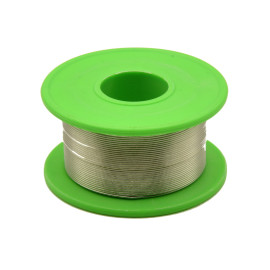
Bobine de soudure sans plomb, SN99.3 CU0.7, diamètre 0.5mm, 50 grammes
Nous avons constaté que de nombreux problèmes d'assemblage signalés par nos utilisateurs débutants sont dus à une soudure inadaptée. Cette bobine devrait éliminer ces problèmes.
Le CP5176 est un compresseur à FET, basé sur le design du compresseur 1176LN, qui a été adapté au format '500' d'API*.
20/03/2025
Super
Excellent compresseur ultra complet, peut être utilisé sur tout un tas de sources sonores, le bouton "dist" rajoute une vraie présence sur les voix,
La compression est très naturelle, on peut compresser 15db et ça sonne toujours bien.
Super également sur des drums pour leur donner un effet disto en rentrant fort dedans.