

Il n'y a plus d'articles dans votre panier


L' EQ573-II est un équaliseur paramétrique basé sur le design et les composants utilisés à l'origine dans les modules 1073 et 1084 des consoles Neve, qui a été adapté au format '500' d'API*.
 Paiements sécurisés
via Paypal, Stripe ou virement
 Livraison monde
Expédition les lundis et jeudis.
 Politique retours
(à modifier dans le module "Réassurance")

L' EQ573-II est un équaliseur paramétrique basé sur le design et les composants utilisés à l'origine dans les modules 1073 et 1084 des consoles Neve, qui a été adapté au format '500' d'API*.
L'EQ573-II peut être utilisé de manière autonome, mais également en tandem avec le préampli MP573, en insertion entre les étages d'entrée et de sortie, recréant ainsi l'architecture complète du 1073.
L'EQ573-II est le successeur de l'EQ573. L'amélioration porte surtout sur la facilité d'assemblage et la fiabilité du produit final. Le comportement audio est le même, les seules différences étant l'absence d'atténuation lors de l'insertion dans un MP573 et la suppression du Q intermédiaire dans la bande moyenne.
Il suffit de l'installer dans votre rack LunchboxTM compatible API* pour commencer l'enregistrement.

1 Fréquence du filtre "High shelf" : De 10kHz à 25kHz (OFF=désactivé).
2 Niveau hautes fréquences : Règle l'atténuation ou l'amplification des fréquences hautes de -16dB à +16dB.
3 Interrupteur Q élevé : Modifie le Q du filtre "Mid band".
4 Frequence du filtre "Mid band": De 270Hz à 10kHz (OFF=désactivé).
5 Niveau du filtre "Mid band" : Règle l'atténuation ou l'amplification des fréquences de -18dB à +18dB.
6 Fréquence du filtre "Low shelf" : De 20Hz à 220Hz (OFF=désactivé).
7 Niveau basses fréquences : Règle l'atténuation ou l'amplification des fréquences basses de -16dB à +16dB.
8 Source Selectionne la source de l'EQ entre la XLR et un préampli MP573 connecté (OFF=bypass).
9 Filtre passe-haut : de 25Hz à 360Hz (OFF=désactivé).
Absolument tout!
Vous n'aurez qu'à apporter la soudure (choisir une soudure de bonne qualité, diamètre 1mm max) et la Lunchbox.
L'EQ573 est un kit assez complexe en raison d'une densité élevée et d'un nombre de composants assez important.
Il n'y a pas de réglage.
| Mesure | Conditions | Valeur |
| Courant d'alimentation au repos | Pas de signal d'entrée | I = +/- 40mA |
| Impédance d'entrée | f=1kHz sur entrée XLR | 20kΩ |
| Niveau d'entrée maximum | sur entrée XLR | +25dBu |
| Niveau de sortie maximum avant écrêtage | sur sortie XLR | +26dBu |
| Amplification/atténuation max hautes fréquences | +/-16dB | |
| Amplification/atténuation max fréquences moyennes | +/-18dB | |
| Amplification/atténuation max fréquences basses | +/-16dB | |
| Atténuation filtre passe-haut | -18dB/octave |
| Code DOCS | Documents |
| depuis DOCS-21 | Manuel utilisateur Nomenclature Implantation des composants Assembly guide Schéma |
| de DOCS-8 à DOCS-20 | Manuel utilisateur Nomenclature Implantation des composants Assembly guide Schéma |
| de DOCS-5 à DOCS-7 | Manuel utilisateur Nomenclature Implantation des composants Assembly guide Schéma |
| de DOCS-1 à DOCS-4 | Manuel utilisateur Nomenclature Implantation des composants Assembly guide Schéma |
The signal proceeds to a second dedicated Class-A gain stage for mid-range processing.
Once the signal has passed through the three equalization bands, it reaches the High Pass Filter and output driver.
The unit utilizes the standard 500-series +/-16V power supply.
Protection: IN4004 diodes (D3, D4) provide polarity protection.
Discrete Audio Rails: Stable local voltage rails (V+a and Va-) for the discrete transistor stages are created using an RC filtering network with C83 (330uF) and C84 (1000uF) capacitors.
This Module was my 2nd DIY build. After I learnd my lesson on my 1st build, what it means to organise all parts befor you start, It was a joy to build this EQ.
And in the end, the most important thing is, this module rocks!!! Compared to my UAD 1073 EQ the EQ curves are very similar and the sonic characteristics are very close, but through the hardware unit, the signal has more body, is more 3 dimensional. I really love this peace of gear. Next thing is building the MP573 an run the EQ through it...Thank you Jean-Pierre for these beautiful kits.
This EQ needs a lot of patience and concentration while building it, but it is absolutely worth the effort. It’s the perfect supplement for the MP573 preamp. I use it in my studio for tracking on every single track. It’s so musical that you rarely need any other EQs with more bands. If the sound is allowed to get coloured in a nice way you can even use it for mastering – I did this and achieved great results in no time (faster than with a Pultec). It’s great that the EQ573 combines the 1073 and 1084 models: You have a bandwidth switch for the mid frequencies and more frequencies available for the high shelf. It’s worth looking at the frequency response while using it (with Waves Q-Clone for instance) – you begin to understand why you don’t need more EQ bands for a perfect sound ;-)
I disagree with the other reviewer here: I don’t find it harsh at all (if you use it "correctly"). But as always, you should also consider using it for cutting the frequencies you don’t need and not only for boosting. With a reasonable combination you have a high class musical sound and lots of possibilities.
For the record, I had never soldered before I bought my first Sound Skulptor kit (CP5176). Also, I am not a trained recording engineer. This is the only Sound Skulptor I would give a 4 (out of 6 I own). What I've noticed after using this for a little over a year is that it can be a bit harsh. I use it more for HF/LF cut, and gentle tuning in the inner frequencies. I run it "inside" of my MP573 (which I love!), and occassionally in series when I am not getting the results I'm looking for. The build is a little tricky getting the pots and set up straight, but I had a lot of fun learning how this parametric structure works.
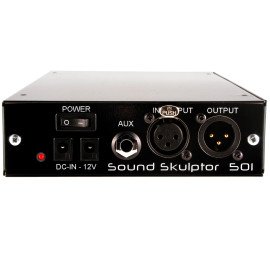
Le SK01 est un boîtier avec une alimentation pouvant héberger un module de la série 500.
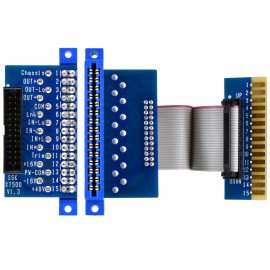
Le XT500 est un câble d'extension qui vous permet de connecter un module de la série 500 à sa Lunchbox out le laissant restant à l'extérieur afin de pouvoir effectuer des réglages ou de la maintenance facilement.

Ce tournevis a une tête encastrée à une extrémité qui l'empêche de glisser de la vis du potentiomètre ajustable que vous réglez. Très pratique lorsque vous travaillez dans votre lunchbox.
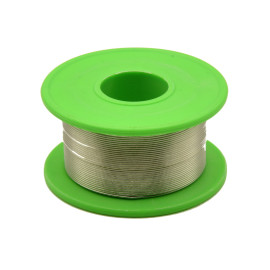
Bobine de soudure sans plomb, SN99.3 CU0.7, diamètre 0.5mm, 50 grammes
Nous avons constaté que de nombreux problèmes d'assemblage signalés par nos utilisateurs débutants sont dus à une soudure inadaptée. Cette bobine devrait éliminer ces problèmes.
L' EQ573-II est un équaliseur paramétrique basé sur le design et les composants utilisés à l'origine dans les modules 1073 et 1084 des consoles Neve, qui a été adapté au format '500' d'API*.
02/04/2026
Great EQ - love it
After the LA502, the EQ573-II was the second module I built. The EQ is significantly more complex than the compressor. The most important thing — and here I agree with the previous speakers — is to take your time. You have to work very carefully, especially when mounting the many capacitors. If you work neatly, they fit well on the board.
And now for the most important part: the sound. It’s a treat to listen with just your ears. I really enjoy working without the distraction of colorful EQ curves.
The highs are addictive. I have to keep reining myself in. With vocals and acoustic guitar, you reach your goal very quickly and put a smile on the musicians’ faces during recording.