
Il n'y a plus d'articles dans votre panier


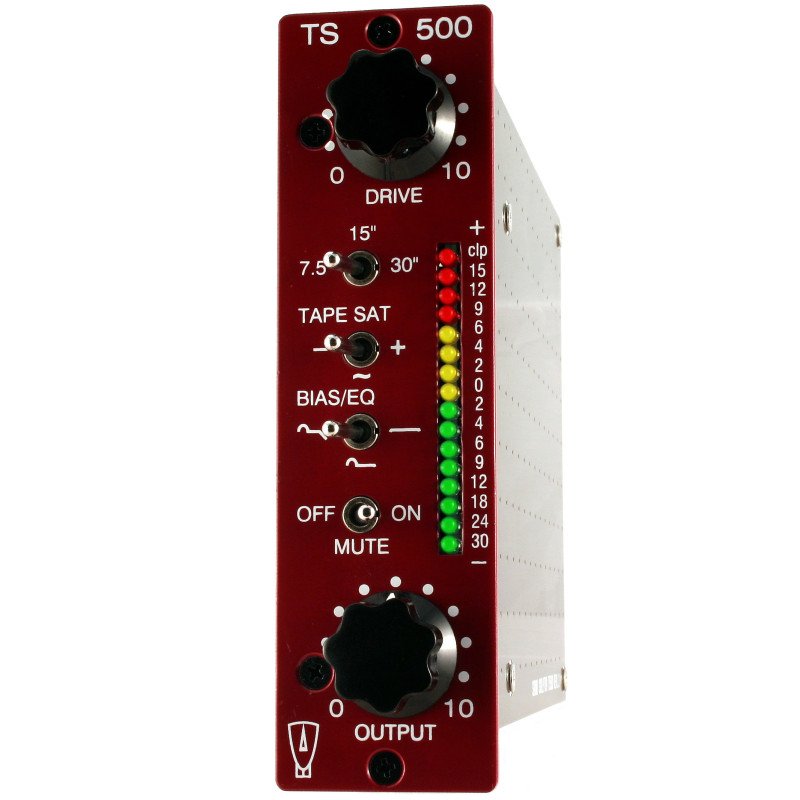
Le TS500 est un processeur analogique qui reproduit la signature sonore d'un magnétophone à bande. Il restitue la rondeur, le punch, la compression et la saturation de la bande magnétique.
 Paiements sécurisés
via Paypal, Stripe ou virement
 Livraison monde
Expédition les lundis et jeudis.
 Politique retours
(à modifier dans le module "Réassurance")
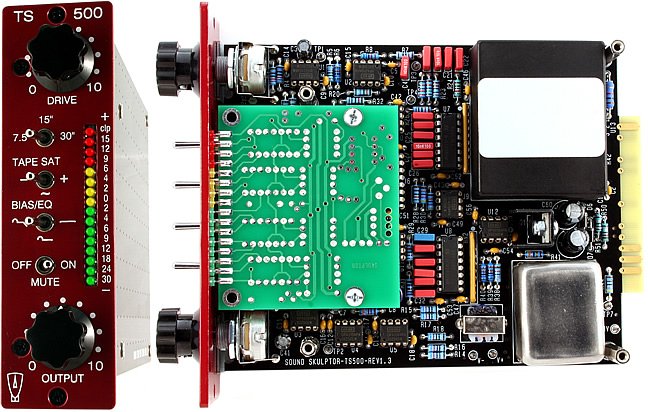
Le TS500 Tape Simulator est le successeur du Stereo Tape Simulator. Il a été adapté au format API* 500 format avec un nombre d'améliorations. C'est un processeur analogique qui recrée l’empreinte sonore des anciens enregistreurs à bandes. L’effet restitue la rondeur, le punch, la compression et la saturation de la bande magnétique. C'est un processeur mono. Deux unités sont utilisées pour la stéréo.
Le TS500 reproduit l'électronique d'un magnétophone à bande vintage avec le transformateur d'entrée, l'étage d'entrée à gain variable, l'étage de préaccentuation, l'ampli d'enregistrement, la tête d'enregistrement commandée en courant constant, l'ampli de lecture, la désaccentuation NAB, et un étage de sortie en pure classe A qui pilote le transformateur de sortie.
Le TS500 émule un enregistreur tournant à 3 vitesses différentes : 7.5 "/s, 15 "/s et 30 "/s. Chaque vitesse donnant une réponse en fréquence différente.
La bande magnétique peut être choisie parmi 3 formulations produisant 3 niveaux de saturation différents de légère à prononcée.
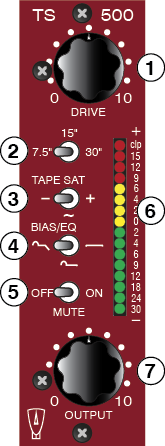
1: Potentiomètre DRIVE Ajuste le gain d'entrée du TS500. L'action du potentiomètre est directement observable sur le Vu-mètre ainsi que sur l'intensité de l'effet.
2: Vitesse de la bande 7.5"-15"-30" Modifie la bande passante et la fréquence du « head bump » de la même façon que le ferait une magnétophone tournant à 7.5, 15, 30 ips.
3: Saturation de la bande 3 formulations de la bande donnent 3 niveaux de saturation depuis [-] une saturation légère à [~] moyenne et à [+] prononcée.
4: BIAS/EQ Définit la manière avec laquelle les réglages de bias et d'EQ vont corriger les défauts de la courbe de réponse du magnétophone.
5: OFF/MUTE/ON
6: Vu-mètre Le vu-mètre haute résolution est l'outil qui vous permet de doser la simulation et d'obtenir des résultats reproductibles. La LED clip en haut indique que le signal écrête dans les étages d'entrée.
7: Potentiomètre OUTPUT Ajuste le volume de sortie et permet de compenser la modification de volume introduite par le potentiomètre IN. Il n'a pas d'influence sur la simulation.
Absolument tout !
Vous apportez la soudure (choisir une soudure de bonne qualité, diamètre 1mm max) et la Lunchbox.
Le kit est d'un niveau de difficulté moyen. Rien de difficile mais un nombre de composants assez important. Une bonne expérience du soudage est nécessaire.
Il y a un seul réglage à effectuer. Un multimètre numérique est nécessaire.
The TS500 is an analog recreation of a professional tape machine's signal chain, shrunk down into a 500-series module. It doesn't just "filter" the sound; it emulates the physics of magnetic recording, from the transformer iron to the non-linear saturation of the tape formulation itself.
1. Input Balancing and Gain
The input is unbalanced by a transformer, providing the initial "iron" character. of a high-quality input transformer.
The signal is first buffered by U1b before hitting the gain controls.
Op-amp U1a acts as the primary gain stage. The Drive control (P1) allows you to push the "virtual tape" harder, increasing harmonic distortion as you increase the signal level hitting the circuit.
2. Pre-Emphasis and Formulation Simulation
Like in a real tape recorder, the signal is "pre-emphasized" (boosted at high frequencies) before being recorded to overcome the noise floor of the tape.
U2a applies the specific NAB EQ curve.
Tape Formulation Simulation (D1, D2, SW1): Using a soft clipping network, the circuit mimics the "soft-knee" compression and harmonic signature of different tapes. SW1 switches between Lo, Mid, and Hi sat settings, effectively changing the "headroom" of the simulated tape formulation.
3. Tape Head Simulation
The signal then moves to a driver stage that simulates the recording head.
Head Driver (U3, U4, U5): A parallel array of op-amps acts as a high-current driver to feed the simulated head.
An actual iron core inductor (HD1) is used to simulate the electrical and magnetic behavior of a recording head, including its inductive reactance and core saturation.
4. Recovery and De-Emphasis
Once the signal has "passed" through the head and tape, it must be decoded.
U2b applies an inverse EQ curve to the pre-emphasis and simulation head, restoring a flat frequency response while leaving the harmonic character intact.
5. Head bumb and frequency response
The TS500 uses active filters centered around U9 and U10 to simulate the head bumb and frequency response at different tape speeds.
The unit uses a quad analog switches (U6, U7, U8) to change RC networks based on the front-panel speed selection.
5. Discrete Driver and Output
A class A stage made of U12, Q1 and U13 provides the current needed to drive the output transformer. U13 is a constant current generator feeding the power tansistor Q1.
Transformer T2 balances the signal for the output, adding one last layer of harmonic weight and smoothing out the transients.
it is a great colour box, but the saturation is very bold. I like it on kicks, bass, and dirt mics. But not on anything fragile. I cannot recommend it for busses and surely not the 2-bus. Plugins sounded a lot cleaner and gave more control here. Though the TS500 is fun and nice to have in the tool kit.
For the record, I had never soldered before I bought my first Sound Skulptor kit (CP5176). My TS500 is a year old now, and still running strong! I use it on nearly everything as anything from light EQ and coloring to full on tape overdrive on vocals. Can be used in post processing too, but I try to get the sound in the ballpark on the front end.
Very cool unit, as a 2bus master thing or to record some sources through it! Better than every software simulation!
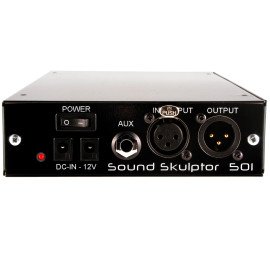
Le SK01 est un boîtier avec une alimentation pouvant héberger un module de la série 500.
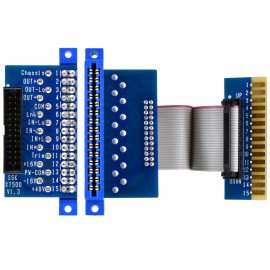
Le XT500 est un câble d'extension qui vous permet de connecter un module de la série 500 à sa Lunchbox out le laissant restant à l'extérieur afin de pouvoir effectuer des réglages ou de la maintenance facilement.

Ce tournevis a une tête encastrée à une extrémité qui l'empêche de glisser de la vis du potentiomètre ajustable que vous réglez. Très pratique lorsque vous travaillez dans votre lunchbox.
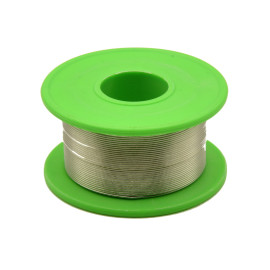
Bobine de soudure sans plomb, SN99.3 CU0.7, diamètre 0.5mm, 50 grammes
Nous avons constaté que de nombreux problèmes d'assemblage signalés par nos utilisateurs débutants sont dus à une soudure inadaptée. Cette bobine devrait éliminer ces problèmes.
Le TS500 est un processeur analogique qui reproduit la signature sonore d'un magnétophone à bande. Il restitue la rondeur, le punch, la compression et la saturation de la bande magnétique.
17/07/2022
Fantastic!
Brilliant unit. Bought two, easy build and set-up. Adds warmth and squeeze to everything, dial-able saturation. Sounds great on drumbus and mix bus. Thank you!